Quick answer
There is no exact clock. The guidance most often repeated, including in EPA advice for homeowners, is to dry wet materials within 24 to 48 hours to keep mold from getting started. Treat that as a planning window, not a promise. Paper-faced drywall, carpet pad and particleboard in a warm, humid house give mold an easy start, and a hidden leak may have started it already.
What mold needs, and the one thing you control
Mold spores are already in practically every house, carried in on shoes, pets and outdoor air. They stay dormant until they land on something they can feed on that is wet enough to grow. Food is everywhere: the paper face on drywall, wood framing, cardboard, dust in carpet and the glue in particleboard. Warmth is a given in a lived-in home. That leaves moisture as the one condition you can actually take away.
This is why mold work always starts with water. Killing the growth you can see does little if the wall behind it is still wet, because spores settle on the damp material again and the cycle restarts. The lasting fix is to stop the source, dry the materials to a measured reading and remove what cannot be dried.
About that 24 to 48 hour figure
You will see the same window quoted almost everywhere: dry water-damaged materials within 24 to 48 hours to prevent mold. The EPA uses it in its guidance for homeowners, and most of the restoration trade repeats it. It is sound advice for planning. It is not a law of nature, and it does not mean mold will or will not appear on any given day.
Actual growth depends on the material, the temperature, how wet the material got and what was on its surface already. A dusty, paper-faced wall in a warm room is a far better home for mold than a glazed tile surround. Read the window as the time you have to get water out and drying started, not as time you can safely wait.
Why League City houses leave less slack
Wet materials dry only as fast as the air around them can take the water. League City spends about 7.2 months a year in muggy weather by WeatherSpark's count, from April 1 to November 8, and July is the muggiest month. Through that stretch the outdoor air is already loaded with moisture, so a wet room gives up its water slowly unless it is closed off and dehumidified.
Attics are the other weak spot. The hot season here runs about four months, late May to late September, with August averaging a 91 degree high. Attic air handlers work through all of that heat, and a condensate pan that overflows soaks the insulation and the ceiling below, often out of sight. Mold can take hold on the attic side of a ceiling well before a stain shows in the room, which is the territory of attic mold removal.
Signs mold has already started
A leak you just found may not be a new leak. A slow drip behind a wall or under a shower pan can run for weeks before anything shows. These signs suggest growth has already begun.
- A musty, earthy smell in one room or cabinet that does not air out.
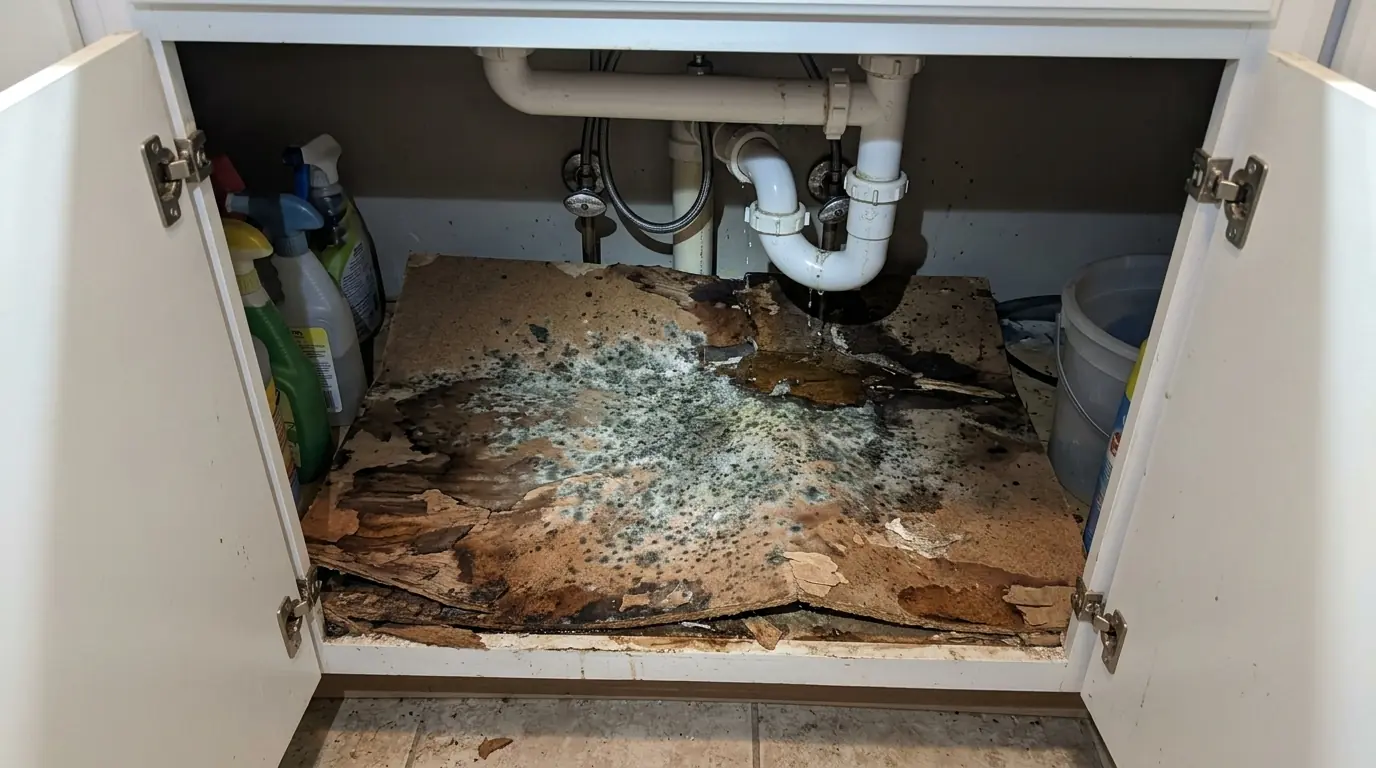
- Gray, green or black speckling on drywall, baseboard or the floor of a sink cabinet.
- Paint that bubbles, peels or yellows on a wall near a bathroom or kitchen.
- Baseboards or cabinet bottoms that are swollen, soft or darkened.
- Fuzzy spots on stored items in a closet that shares a wall with a bathroom.
Smell is often the first warning. If you can smell it or see it, you already know enough to act, and testing is rarely needed to decide that the wet material has to be dealt with.
Smell something musty after a leak? Call and we will find the moisture.
Call (832) 737-0315What to do the day you find it
Small spots on hard, nonporous surfaces like tile or a tub surround can be cleaned with detergent and water. Growth that has worked into drywall, carpet or wood is a different job, and these steps keep it from getting bigger.
- Stop the water source, or have a plumber stop it, before anything else.
- Leave growth on drywall, carpet or wood alone, since scraping it dry throws spores into the air.
- Keep fans from blowing across it, which carries spores to clean rooms.
- Skip the bleach on drywall and wood. It can whiten the surface while its water soaks into the material.
- Keep people with asthma, allergies or weak immune systems away from the area.
- Close the door to the room and call for an inspection.
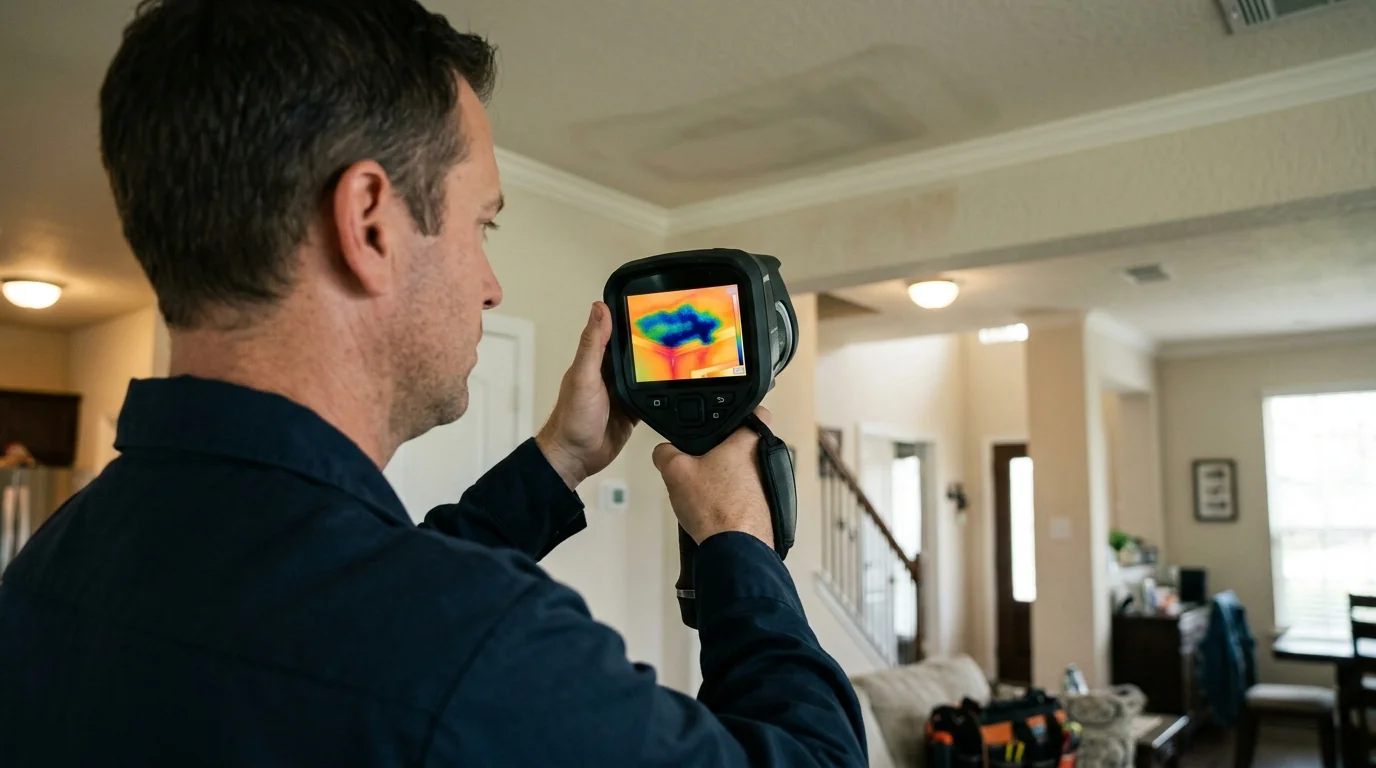
Proper mold remediation begins by finding the moisture that fed the growth, which is the job of moisture readings and thermal imaging.
How careful removal keeps it from coming back
Mold removal done right looks more like careful demolition than cleaning. We close the area off with plastic sheeting and run filtered air under negative pressure, so spores stay inside the work zone. Moldy drywall, insulation and pad are cut out and bagged inside that containment. Framing is cleaned, sanded where growth went into the surface, and HEPA vacuumed.
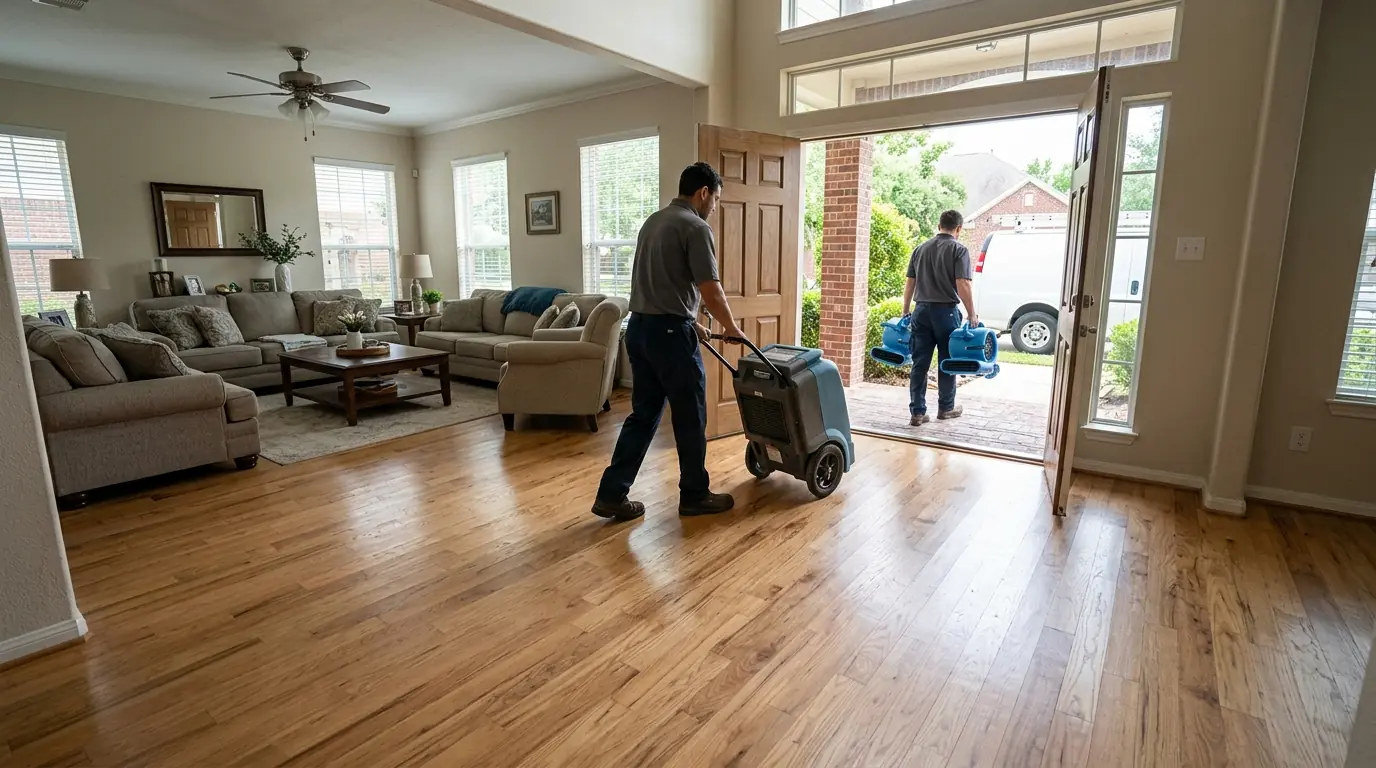
Then comes the step people skip, which is drying. Framing goes back to its dry reading before anything is closed up, and an antimicrobial is applied to the cleaned surfaces. If the original leak is still active, none of this holds, so the source is fixed first. Our guide to how long structural drying takes covers that final stage.
Keeping the next leak from turning into mold
Most mold jobs trace back to a leak that was small at first. A few habits catch them earlier. Look under sinks and around the water heater each time you change the AC filter. Check the attic condensate pan and its float switch before summer. Run bathroom fans during and after showers, and let the AC run long enough to pull humidity out of the house. A musty smell is worth chasing down the week you notice it.
Mold timing questions
Some sources say growth can begin that soon in ideal conditions, and others say a few days. Nobody can tell you the hour for your wall. What holds true is that drying started on the first day leaves mold far less to work with than drying started later.
Growth goes dormant when the material dries, but it stays in the drywall or wood, where it can still smell, stain and start again with the next leak. Porous materials with growth are usually removed, and hard surfaces are cleaned.
Usually not when you can see growth or smell it. Testing can help in narrow cases, such as a strong musty smell with no visible source. Either way, the first job is still finding the moisture and drying it out.
Color does not tell you the species or the risk, and many common molds look dark. Any mold growing indoors calls for the same response: find the moisture, remove what is contaminated and dry the structure.
No. Paint, even mold-resistant paint, seals growth in without dealing with it, and the moisture behind it keeps working. It usually shows through again or makes the paint peel. Remove the growth and dry the wall first.
