Updated October 2026
Quick answer
Pet urine odor in a League City carpet usually lives in the pad and on the slab under it, not in the fibers on top. Urine salts pull moisture from humid air, so a spot cleaned only on the surface smells again. Treatment means finding every spot and flushing or replacing what sits below it.
Why urine smell outlasts a surface cleaning
A puddle the size of a dinner plate on the carpet often spreads much wider in the pad, the way ink spreads on a paper towel. Drying urine leaves salts behind. Those salts take on water whenever the air turns damp, and the smell rises again over a carpet that looks clean.
So the work starts with mapping, not cleaning. Each spot is marked at its true edge, then rinsed through the carpet, treated from below, or cut out along with its pad. Odor that has spread into walls, drapes or furniture calls for whole-house odor removal.
What changes the price of urine odor treatment
The number of spots and how deep each one went set the price, so the room is mapped before we quote.
- Number of spots
- One fresh accident is a short visit; a room of old spots is a larger job.
- Depth
- Spots that stayed in the pad cost less to fix than ones that reached the slab.
- Pad and tack strip
- Cut-out pad, new strip and reinstalling the carpet add materials and labor.
- Subfloor sealing
- Concrete or plywood that needs treatment and primer adds a drying step.
Published national planning ranges
- Carpet cleaning, per room: about $35 to $150 per room (inchcalculator.com, 2023)
These are national figures from published cost guides, shown for planning only. They are not a quote and not our price list; your job is priced after we see it.
Handling a fresh accident before we get there
Skip ammonia cleaners, which smell like urine to many pets, and never mix bleach with another product.
Do this now
- Blot fresh urine with white towels, standing on them
- Rinse once with cool water and blot again
- Keep the pet out until the spot dries
- Mark known spots with painter's tape
Call us when
- The smell returns on humid days
- Spots have soaked into the pad
- Old spots line the walls
- A rental machine spread the urine
Finding urine with UV light and a moisture probe
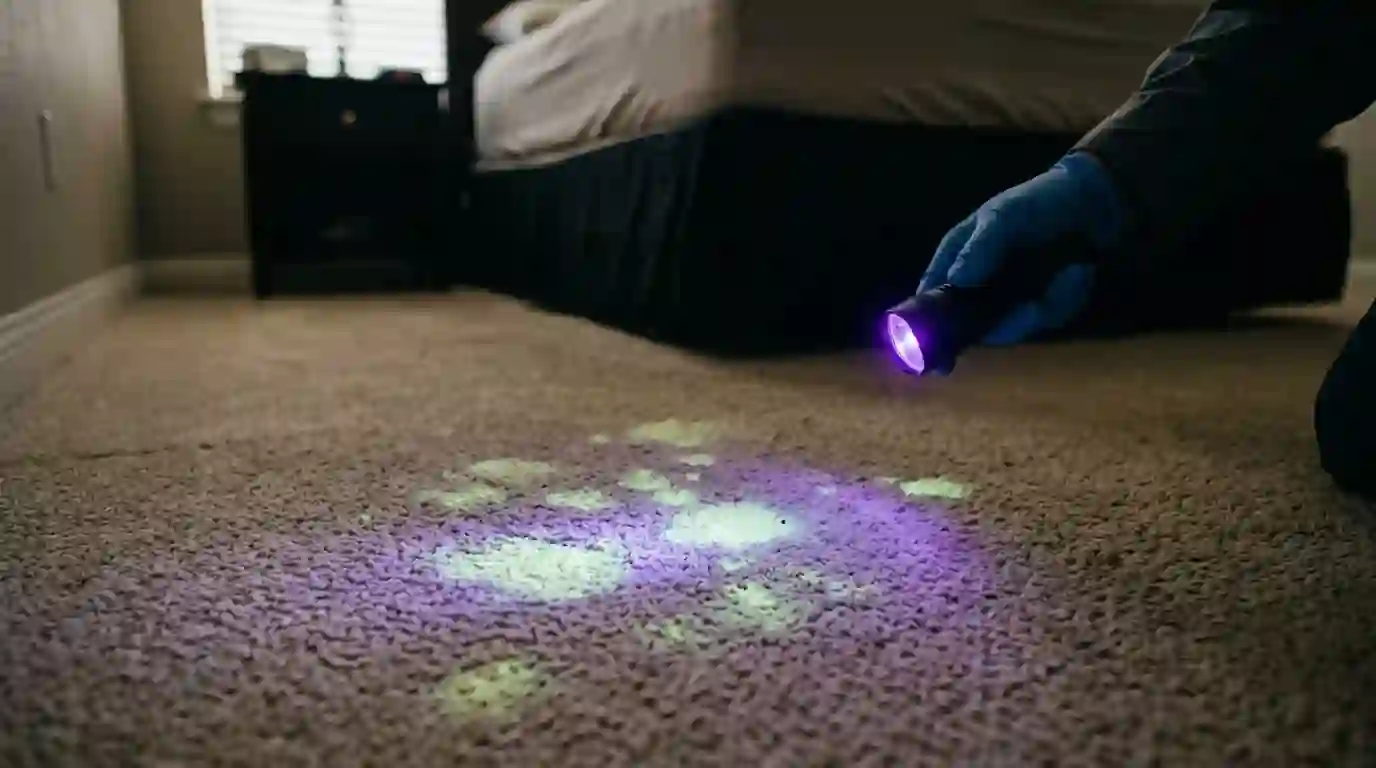
Most owners know about one or two spots. In a darkened room, a UV lamp makes dried urine glow, and old spots along baseboards and behind furniture usually show up as well. UV also lights some cleaning residues and fibers, so each glowing area is confirmed with a moisture probe pushed through the carpet into the pad. The probe shows how far the spot spread underneath. That edge decides how much gets treated and whether that piece of pad can stay.
Subsurface extraction for spots that reached the pad
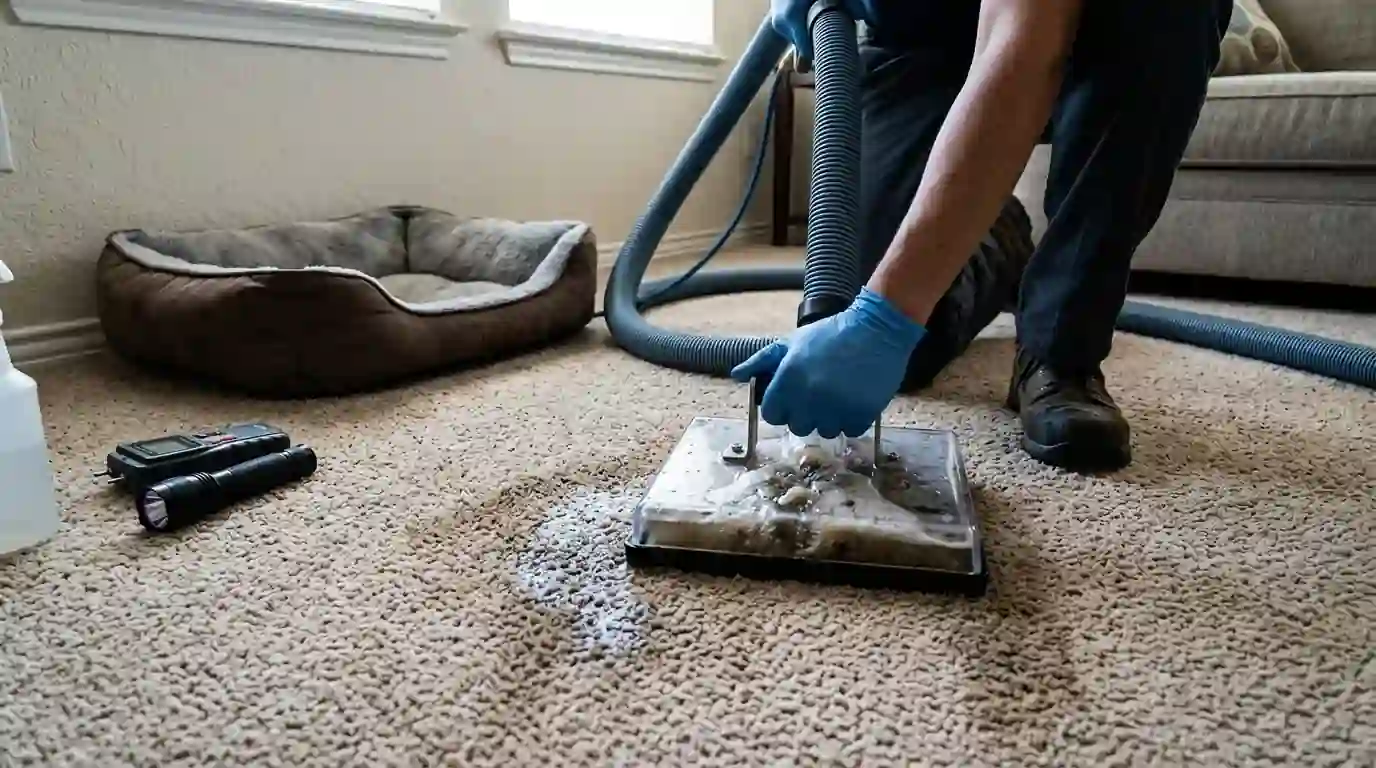
When urine has soaked into the pad but not past it, the spot is flooded with a urine treatment so the solution reaches as deep as the urine did. After it dwells, a subsurface extraction tool presses on the carpet and draws the liquid back up through the pad, pass after pass, until the rinse comes up clear. This saves carpet and pad on fairly fresh, one-time spots. A corner used again and again has usually saturated the pad beyond what any rinse can recover.
Pad and subfloor treatment when urine went all the way down
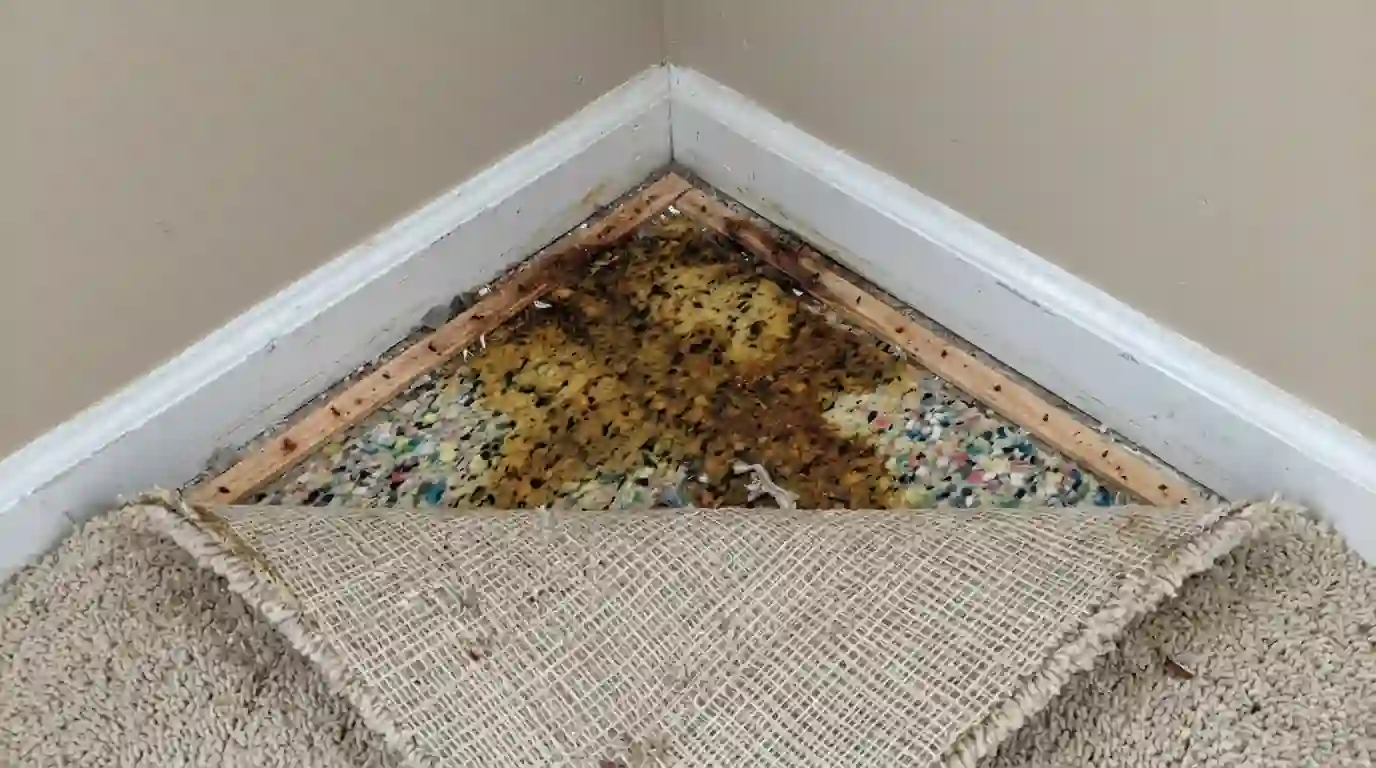
Old or repeated spots soak through the pad into the slab or wood subfloor, and the wooden tack strip along the wall drinks it up too. We pull back the carpet, cut out the contaminated pad and remove any stained strip. The concrete or plywood gets an enzyme or oxidizer treatment, dries, and is sealed with an odor-blocking primer. New pad and strip go in, and the carpet is reinstalled, stretched and cleaned. The carpet itself is usually kept unless its backing has come apart.
From the first UV pass to the final rinse
Map the spots
UV light and a moisture probe locate each spot and its edge.
Choose the depth
Each spot gets a rinse, a pad cut-out or a slab treatment.
Treat and dwell
Enzyme or oxidizer goes as deep as the urine and is given time.
Extract or replace
Saved pad is flushed from below; ruined pad and strip are replaced.
Clean and recheck
The carpet face is cleaned and each spot probed again.
Humid League City air and the smell that comes back
League City sits close to Galveston Bay, and for much of the year indoor air here carries more moisture than in drier parts of Texas. That moisture reactivates dried urine salts, so a corner that seemed fine in a cool, dry week can smell strong after a run of muggy days. A closed-up house with the AC set high for a trip does the same. Houses here typically sit on concrete slabs, and an untreated slab under an old spot keeps feeding odor into new pad.
Signs urine has reached the pad or slab
Smell stronger on humid days
The odor rises after rain or when the AC has been off.
A stiff or crunchy patch
Dried urine leaves the yarn rough in one place.
Yellow rings that return
Marks reappear after cleaning as residue wicks up from below.
Pet circling one corner
Animals go back to spots that still smell to them.
Odor strongest along a wall
Urine runs to the edge, where the wooden tack strip holds it.
What pet owners ask about urine smell
Dried urine salts absorb moisture from humid air and release odor again. Our article on why pet urine smell returns explains it in plain terms.
Not always. A slab soaked for years can be treated and sealed, which usually controls the smell, and we say up front when a spot is past saving.
On a fresh spot it can help, if you soak it as deep as the urine went and keep it wet. Sprayed lightly on top, it barely reaches the pad.
Pets return to places that still smell like urine to them. Treating the pad and slab removes that cue, and blocking the spot while it dries helps break the habit.
Yes, during treatment and until the carpet is dry. We name each product we put down, so you can ask your vet about anything specific.
