Quick answer
Air duct cleaning helps when there is a specific problem inside the system: visible mold growth in hard ducts or the air handler, rodents or insects in the ducts, heavy debris blowing out of the registers, or drywall dust from a remodel. Ordinary dust lining the duct walls is normal, and the EPA does not recommend cleaning ducts on a routine schedule.
What the EPA says about cleaning ducts on a schedule
The Environmental Protection Agency's guidance on duct cleaning is plainer than most advertising. It does not recommend cleaning air ducts routinely, only as needed. It notes that much of the dirt in ducts sticks to the duct surfaces and does not necessarily enter the living space, and that duct cleaning has never been shown to prevent health problems.
The same guidance names the cases where cleaning makes sense: substantial visible mold growth inside hard ducts or other parts of the system, ducts infested with rodents or insects, and ducts clogged with excessive dust and debris, or releasing particles into the home through the supply registers. We agree with that list. In practice, one more case belongs beside it: heavy drywall and sanding dust pulled into the returns while the system ran during a remodel.
Four situations where cleaning earns its cost
Each of these is something you can see or confirm, not a guess based on how long it has been:
- Mold growing inside the system, seen on sheet metal ducts, the blower, the coil or the drain pan during a look inside.
- Rodents or insects, shown by droppings, nesting material or dead pests in the ducts or the return plenum.
- Debris blowing out of the registers, such as puffs of dust when the system starts, even with a fresh filter in place.
- Remodel dust, from drywall sanding, sawing or demolition, drawn into the returns while the system ran.
If one of these fits, air duct cleaning is worth doing, and worth doing completely. Water and mold work in the house is a related case. After mold remediation in a room that a return pulled air from, the system is checked so it does not carry dust from the work area into clean rooms.
Situations where cleaning probably will not change much
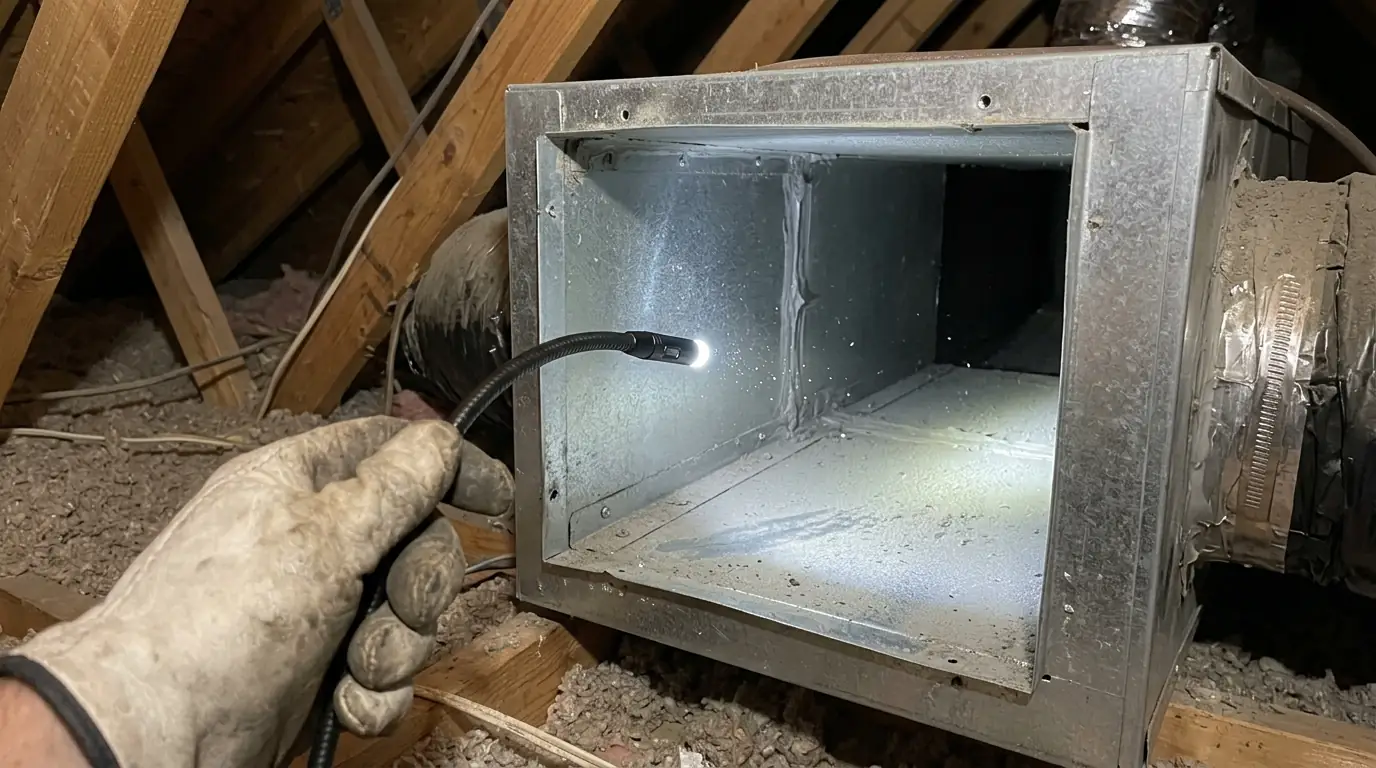
A little dust on the return grille, or a light gray film just inside the duct opening, is normal in any house that runs its system. Much household dust comes from people, pets, fabric and outdoor dirt, and clean ducts do not stop any of those.
Allergies are a harder call. If someone in the house has unexplained symptoms and a look inside shows heavy dust or growth, cleaning may help. If the ducts look ordinary, a better filter changed on time and indoor humidity kept in check usually do more for the air.
Newer houses rarely need it either, unless the system ran during drywall finishing. The typical League City home dates from 2003, the median build year, and about 58 percent of local housing was built in 2000 or after. In a younger house, age alone is not a reason to clean the ducts. One of the specific problems above is.
Black spots on ceiling registers in a humid house
Dark spotting on ceiling registers and the drywall around them is common in Gulf Coast homes, and it is usually condensation, not dirty ducts. Cold supply air meets warm, humid room air at the grille. The metal sweats, and mold grows on the wet surface.
The causes sit outside the duct interior: a gap where the register boot meets the drywall and lets hot attic air in, a boot with poor insulation, high indoor humidity, or a system that runs short cycles and never pulls enough moisture out. The grille and the drywall around it can be cleaned, but the spots return until the cause is fixed, which is usually work for an HVAC company.
Timing points to the cause too. WeatherSpark counts roughly four hot months here, late May through late September, and August's average high is 91 degrees. That is when the system runs longest, the attic is hottest, and sweating registers show up most.
Dust puffing from the vents? Call and describe what you see first.
Call (832) 737-0315What a complete duct cleaning should include
If the system does need cleaning, a partial job wastes the money. Debris left in the blower or the return plenum is blown back into the clean ducts the next time the system runs.
- Every supply and return run, cleaned under negative pressure so loosened debris is pulled out instead of pushed into rooms.
- Supply registers, return grilles and the return plenum.
- The blower wheel and housing, where dust cakes onto the fan blades.
- A look at the coil and condensate drain pan, with anything that needs HVAC service pointed out to you.
- Photos from inside the ducts before and after, so you can see what came out.
- A new filter that fits its slot with no gaps around the edges.
Flexible duct, the round insulated duct common in Houston-area attics, needs gentler tools than sheet metal, because stiff brushes can tear the inner liner. Fiberglass duct board or lined duct that has been wet or has mold in the insulation cannot be cleaned well, and the EPA recommends replacing it. You should hear that before the work starts.
Questions to ask before anyone opens the system
These five questions separate a useful job from a wasted one:
- What did you see inside the ducts, and can I see the photos?
- Will the blower, plenum and grilles be cleaned along with the ducts?
- Will the system be under negative pressure during the cleaning?
- Are you planning to spray anything into the ducts, and why?
- Is there a cause, such as a leak, a pest entry or a humidity problem, that needs fixing first?
On chemicals, the EPA is cautious. It says research has not shown that sanitizers and sealants sprayed inside ducts work, and that sealants should never cover wet duct liner, active mold or debris. Ask for the product name and read its label before agreeing to it.
Simple fixes that often do more for indoor air
Before paying for a duct cleaning, check the basics. They cost little and often fix what people hoped the cleaning would.
- Change the filter on the schedule its maker gives, and sooner during the hot season or a remodel.
- Keep indoor humidity in check, which matters more in this climate than clean duct walls.
- Seal gaps at register boots and return grilles so the system is not pulling attic air.
- Clean the dryer vent on its own schedule, because lint in a long vent run is a fire and moisture risk that duct cleaning does not touch.
A dryer vent cleaning is a separate job with its own tools, and a clogged vent shows up as long drying times and a hot laundry room.
Duct cleaning questions we hear from homeowners
No fixed schedule fits every home. The EPA recommends cleaning only as needed, when there is mold growth, pests or heavy debris in the system. A look inside with photos answers the question for your house.
Ducts rarely start a mold problem by themselves. Mold in a duct system needs moisture, usually from a wet coil, a clogged drain pan, a leak or condensation. Fix the moisture first, then clean what grew, or the growth comes back. Our article on how quickly mold follows a leak covers that timing.
Probably not by much. The EPA notes little evidence that cleaning the ducts alone improves efficiency. A clogged filter, a dirty coil or a torn duct in the attic matters far more, and those are worth checking first.
If water reached the air handler, a low return or the ductwork, yes, and wet duct insulation is usually replaced. If the water stayed on the floor and the system ran normally, a look inside with photos is enough to decide.
It can be, especially if the previous owners smoked or kept pets, or the house sat closed up for months. Ask for photos from inside first. If the ducts are torn or crushed flex duct, replacement may make more sense than cleaning.
