Quick answer
Wet carpet usually stays when three things line up: clean water, fast extraction, and backing that has not separated. Pad soaked by clean water can often be dried too. Gray water means new pad and cleaned carpet. Sewage and floodwater from outside, Category 3, mean both carpet and pad are removed.
The water category decides most of it
Restoration work sorts water into three categories, and the category sets the starting point before anyone touches a meter. Our guide to water categories covers each one in depth. Here is how they play out on carpet.
- Category 1, clean water: a supply line, a sink overflow, rain through an open window. Both layers are usually candidates for extraction and in-place drying.
- Category 2, gray water: a washing machine drain, a dishwasher, an aquarium, an AC condensate line. The pad is replaced, and the carpet is cleaned, dried and usually kept.
- Category 3, sewage or water from outside: a toilet backup with waste, a main line backup, rising water from a street or creek. Carpet and pad are both removed.
Water also changes category as it sits. A clean leak that runs unnoticed for days, or that picks up soil and building debris on its way across the floor, can no longer be treated as clean. That is why the time before extraction matters as much as the source.
How long it sat, and why the first day counts
Clean water does not stay clean in a warm house. Bacteria already living in carpet and pad start to multiply, and the water picks up whatever it passes through. In League City, with warm, humid air for most of the year, that process does not wait.
Carpet that was extracted and set up for drying the day it got wet has the strongest odds. Carpet that sat soaked over a weekend has far weaker odds, and a sour or musty smell is often the first sign the chance has passed.
Fast water extraction is the biggest factor you can still control after a leak. Weighted extraction tools pressed into the carpet pull water out of the pad itself, which removes far more than air movers alone ever could.
What happens to the pad underneath
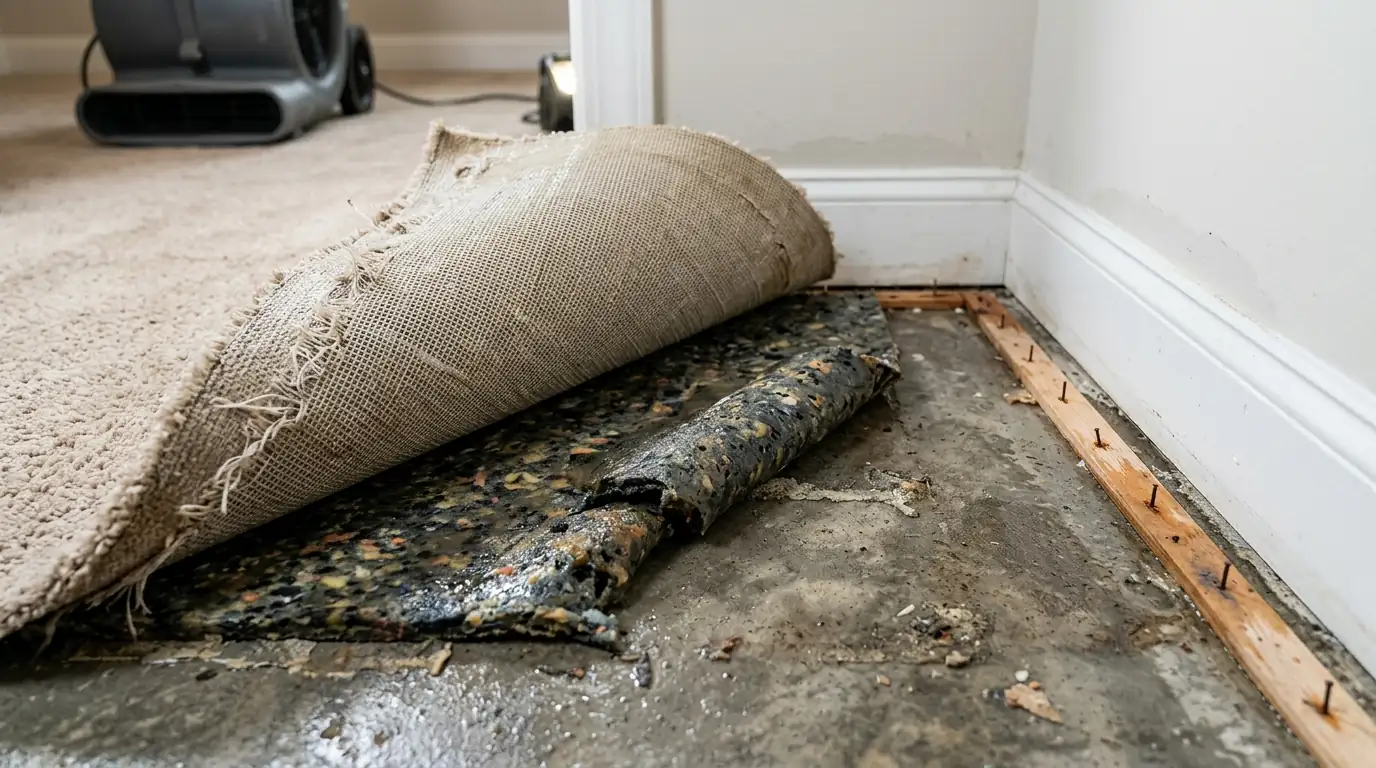
Pad is the foam layer under the carpet, and it soaks up and keeps water much like a bath sponge. In a clean water loss caught early, it can be dried in place: water is extracted through the carpet, then air is floated between carpet and pad, or the carpet is lifted so both sides dry. That is the core of drying wet carpet and pad in place.
Pad is often replaced even in a clean water job when it has been wet a long time, when it is old and crumbling, or when new pad costs less than the extra days of drying. It is inexpensive next to carpet, and it rests right on the slab or subfloor, where trapped water turns into odor later.
With gray water, the pad goes no matter how quickly the water was caught. Foam cannot be cleaned all the way through, and whatever the water carried stays inside it.
Signs the carpet itself cannot be saved
Even with clean water and quick action, some carpet does not come back. These are the conditions we check before recommending replacement:
- Delamination, where the secondary backing separates from the primary backing and shows as bubbles that will not stretch flat.
- Shrinkage that pulls the carpet off the tack strip too far to stretch it back to the wall.
- Browning or dye bleed, such as brown tips on light carpet or colors running together, seen most with jute backing and natural fibers.
- A sour or musty odor that stays after the carpet reads dry, which points to growth in the backing.
- Visible mold on the back of the carpet or on the pad.
- Any Category 3 water, however the carpet looks.
A small patch of separated backing can sometimes be glued back with latex adhesive, but a whole room of it is a replacement. Ripples from a short wetting usually flatten with re-stretching once it is dry.
Carpet still wet? Call and we will help you sort what can be saved.
Call (832) 737-0315Age, value and matching: the money side of the decision
The carpet's condition before the leak matters too. Drying a newer carpet in good shape usually costs less than replacing it. Drying a worn, stained carpet that was due for replacement may not justify the equipment time, and some owners choose new carpet even when the old one could be saved.
Matching is the other question. If water reached one room of carpet that runs through several, new carpet in that room may not match the rest in color or wear. How a claim treats that depends on the policy and the adjuster, so photograph the whole run of carpet, not only the wet part. Our article on what a homeowners policy covers goes further.
If carpet is removed, keep a cut sample of carpet and pad, mark which room it came from, and photograph any maker printing on the back. Adjusters often ask for it, and once the roll is at the curb it is gone.
Checks you can make before anyone arrives
Stop the water first. Then a few simple checks tell you how big the problem is:
- Press a dry white towel into the carpet at the edge of the wet area and a few feet beyond it. Damp towels outside the visible spot mean water traveled in the pad.
- In a closet corner, lift the carpet off the tack strip with pliers and feel the pad underneath.
- Smell the area. Clean water smells like nothing, while a sour or sewer smell points to the category.
- Look at baseboards and the bottom of the drywall for swelling or a dark line.
- Photograph everything, then move what you can off the wet carpet and set foil or plastic under the legs of anything that stays.
Do not run a household upright vacuum over wet carpet, and do not walk on carpet soaked by sewage or floodwater without boots and gloves.
Floodwater and sewage: why nothing is dried in place
When water comes in from outside, it is Category 3, the same as a sewage backup. It has crossed streets, yards and ditches, and it carries soil, fuel, lawn chemicals and bacteria into everything it soaks. Clear Creek rising is a recurring League City flood story in the Galveston County Daily News, and water from the creek falls in this category.
In a Category 3 loss, carpet, pad and usually the tack strip are removed, the slab gets cleaned and disinfected, and drying finishes before new flooring goes down. Our flood cleanup page walks through that tear-out. Area rugs are the one exception worth asking about, since some valuable wool rugs can be decontaminated and cleaned depending on the rug and how long it sat.
Wet carpet questions homeowners ask us
For a small clean water spill caught right away, a wet vacuum and fans can work. Once the pad is soaked or the water covers a room, fans dry the surface while the pad stays wet against the slab, and odor follows.
The carpet and pad decisions are the same, but water on a second floor soaks into the wood subfloor and often reaches the ceiling below. The subfloor and the ceiling cavity both need readings, and drying runs on two levels at once.
It can if the carpet and pad stay wet. Prompt extraction and drying to a measured target usually prevent that in a clean water loss. A musty smell after drying is a warning that something underneath stayed wet.
Some carpet shrinks or loosens as it gets wet and dries, which can leave ripples or pull it off the tack strip. Ripples are often fixed by re-stretching after drying, while heavy shrinkage may mean replacing a section.
Installed carpet and its pad should go once outside floodwater has soaked them. That water leaves sewage, soil and chemicals deep in the backing and foam, beyond what any cleaning can fully rinse out. Some valuable area rugs can be professionally decontaminated.
